Reach out to us directly for quick support, project inquiries, or opportunities.
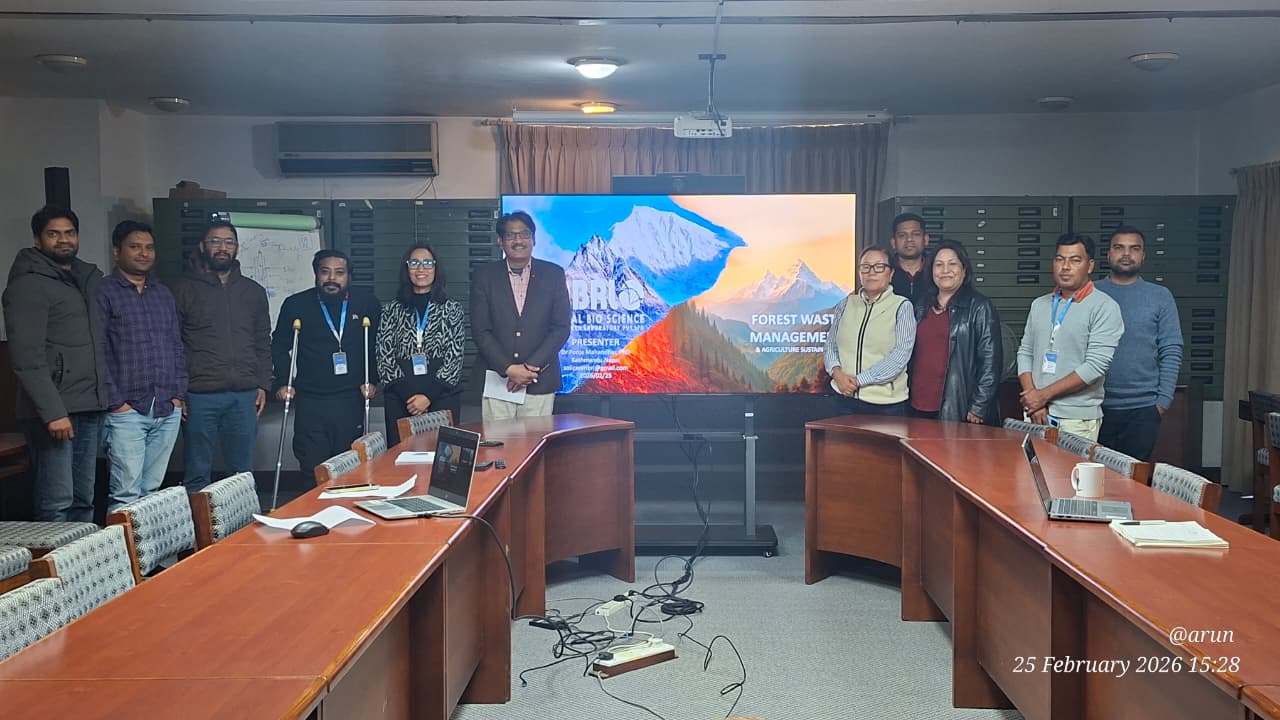
Consultancy Service on Technical Support to ICIMOD, Lalitpur, Nepal, for Ex-situ Management of Forest Residue through Composting
Project Location: Lele, Godawari Municipality, Lalitpur, Nepal
Coordinates: 27.574676° N, 85.358490° E
Implemented by: Nepal Bioscience Research Laboratory Pvt. Ltd. (NBRL)
Technical Support to: ICIMOD, Lalitpur, Nepal
Nepal Bioscience Research Laboratory Pvt. Ltd. successfully completed the consultancy project “Ex-situ Management of Forest Residue through Composting” in Lele, Godawari Municipality, Lalitpur. The project was designed as a foundational study toward sustainable forest biomass management, wildfire risk reduction, soil restoration, and circular bioeconomy development.
The project focused on converting unmanaged forest residues such as broadleaf litter, pine needles, twigs, shrubs, and woody biomass into valuable bio-organic fertilizer through scientifically managed windrow composting. Field activities included stakeholder consultation, GIS-based site assessment, biomass resource assessment, soil sampling, microbial investigation, biomass shredding, compost pile establishment, temperature monitoring, and preliminary enterprise development planning.
A total of 12 composting piles were established, including treatment and control piles with different biomass compositions and microbial applications. Initial compost monitoring recorded thermophilic temperatures of 54°C to 60°C, indicating active microbial decomposition and successful composting initiation.
The project demonstrated that unmanaged forest biomass can be transformed from a wildfire hazard into a valuable agricultural resource. By promoting ex-situ composting, the initiative supports forest fire risk reduction, improved air quality, soil health restoration, organic agriculture, and local livelihood development.
The study also identified strong potential for a community-based forest biomass enterprise. Field assessment showed that one worker can collect approximately 45.5 kg of biomass per hour under steep terrain conditions. A five-worker collection team could mobilize around 524.16 tons of biomass annually, producing an estimated 183–262 tons of bio-organic fertilizer products per year.
This project provides a practical and science-based model for converting forest residues into climate-smart agricultural inputs. The findings will support future compost quality validation, microbial enrichment, product development, business planning, market assessment, and expansion to other Community Forest User Groups across Nepal.
From forest residue to soil restoration, climate resilience, and community enterprise.

We are a purpose-driven environmental organization dedicated to protecting nature, restoring ecosystems.
Subscribe to receive update environmental initiatives, impact stories.
Copyright © 2026 All Rights Reserved.