
Author: Env. Er. Arun Lama
Environmental Engineer, Nepal Bioscience Research Laboratory Pvt. Ltd. (NBRL)
Modern agriculture often evaluates soil through nitrogen, phosphorus, potassium, pH and crop yield. These indicators are essential, but they describe only part of what makes soil productive, resilient and sustainable.
Soil is not simply a medium that holds plant roots. It is a living ecosystem.
At the centre of this system are two inseparable components: soil organic matter and microorganisms. Organic matter provides carbon, energy, nutrients, habitat and physical structure, while microorganisms transform these resources through decomposition, nutrient cycling, mineralization and interactions with plant roots.
In simple terms, I describe organic matter as the heart and energy reserve of soil, while microorganisms function as its biological engine and information network.
Half of Life is lost in charming others. The other half is lost in going through anxieties caused by others. Leave this play, you have played enough.
Organic Matter and Microbial Life Must Be Managed Together
For many years, soil organic matter was understood mainly as decomposed plant and animal residues. Modern soil microbiology has expanded this understanding.
Microorganisms actively transform plant-derived carbon into microbial biomass, metabolites and cellular residues. These materials can later contribute to the formation and stabilization of soil organic matter.
Research published in Nature Communications has provided direct evidence that microorganisms contribute to soil organic matter formation, while studies in Nature Geoscience have highlighted the importance of microbial necromass—the residues of dead microbial cells—in soil carbon stabilization.
This means that restoring soil organic matter is not only about adding compost, manure or crop residues. It is also about creating conditions in which a functional microbial community can process, recycle and stabilize that carbon.
Carbon feeds biology. Biology transforms carbon. Together they sustain living soil.
The Soil Microbiome Is an Agricultural Resource
Healthy soils contain highly diverse communities of bacteria, fungi, archaea and other microorganisms. These organisms participate in processes that directly affect agricultural productivity.
Some microorganisms contribute to nitrogen fixation, while others mobilize phosphorus and other nutrients. Many interact with plant roots, participate in decomposition, influence plant growth, compete with pathogens or improve plant response to environmental stress.
A major review published in Nature Reviews Microbiology highlights the potential of plant-associated microbiomes for sustainable crop production, including plant nutrition, stress management and crop protection.
However, one major challenge remains:
A microorganism that performs well in the laboratory does not automatically perform equally well under field conditions.
Why Locally Adapted Microorganisms Matter
When a microbial inoculant is introduced into soil, it enters an already complex ecosystem.
The introduced organism must survive local temperature, moisture and soil chemistry. It must interact with existing microorganisms, respond to the target crop and establish itself in a suitable ecological niche.
This makes ecological compatibility extremely important.
A particularly important review published in 2026 in npj Sustainable Agriculture, a Nature Portfolio journal, examined microbial inoculants and root microbiomes in sustainable agriculture.
The review emphasizes that the success of microbial inoculants depends on several interconnected factors, including environmental filtering, plant-host selection, resident microbiomes, microbial interactions, formulation, storage, persistence and field conditions.
This has major implications for agricultural biotechnology.
The effectiveness of a microbial inoculant cannot be understood by studying the microorganism alone. We must consider the complete system:
Microorganism + Plant + Soil + Resident Microbiome + Environment + Formulation + Management
This is one of the strongest scientific reasons to explore locally adapted microbial resources.
Indigenous Microbial Technology
At NBRL, our work has encouraged me to think about microbial biotechnology from a local ecological perspective.
Nepal possesses enormous diversity in soils, crops, vegetation, climate and microbial ecosystems. These environments represent a significant biological resource.
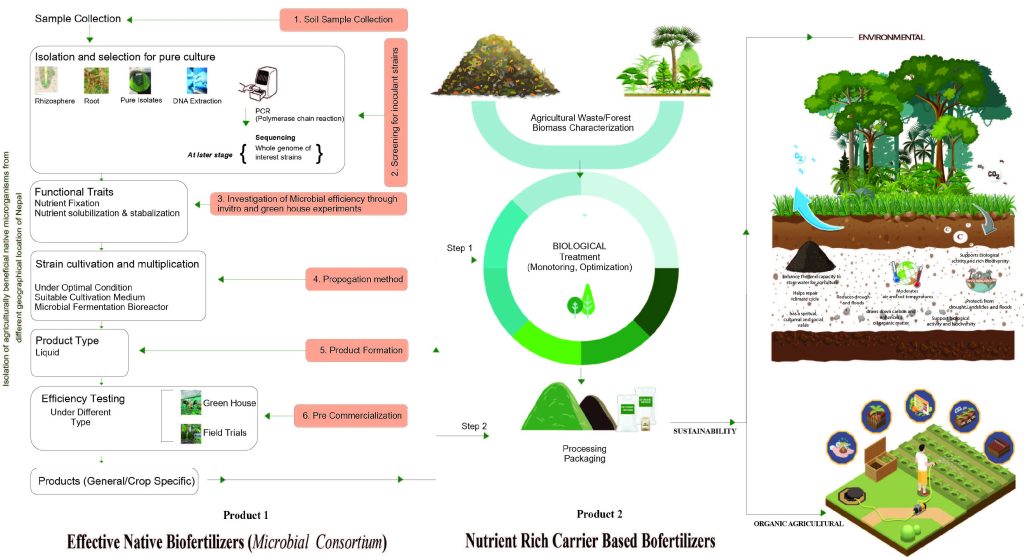
By Indigenous Microbial Technology, I refer to the scientific exploration and development of microorganisms originating from local environments and their possible application in agriculture, organic-waste management and environmental biotechnology.
However, local origin alone does not make a microorganism effective.
The technology-development pathway should include:
Local microbial diversity → Isolation → Identification → Functional characterization → Compatibility assessment → Formulation → Quality control → Field validation → Monitoring
Local microbial diversity should be the starting point.
Scientific validation should determine the technology.
From Microbial Products to Precision Biological Technology
The biological-input sector is growing rapidly. Biofertilizers, microbial biostimulants, decomposers and microbial biocontrol products are increasingly being explored as part of sustainable agriculture.
But the next generation of microbial technology should move beyond simply introducing microorganisms into soil.
We need precision biological technology.
This means developing microbial solutions according to crop requirements, soil properties, organic matter, native microbiomes, climatic conditions and farming systems.
Such an approach can help improve the reliability of biological products and reduce unrealistic expectations associated with universal microbial solutions.
From Organic Waste to Biological Resources
These same microbial principles also apply to waste management.
Agricultural residues, food waste, livestock residues, forest biomass and agro-industrial by-products contain valuable carbon and nutrients. When poorly managed, they can become environmental problems.
When biologically managed, they can become resources.
Microorganisms drive decomposition, stabilization and nutrient transformation. This creates opportunities for composting, microbial decomposer technologies, organic fertilizers, biofertilizers, soil restoration and circular bioeconomy development.
Waste-management companies should therefore increasingly move from waste disposal toward biological resource recovery.
Instead of asking, “How do we dispose of this organic waste?” we should ask:
“How can biological processes transform this material into a valuable resource for soil, agriculture and the environment?”
The Future of Agriculture Is Biological — But It Must Be Scientific
I strongly believe biological technologies will become increasingly important in the future of agriculture.
But microbial technologies should not be promoted through exaggerated claims.
They must remain grounded in microbial ecology, soil science, biotechnology, formulation science, quality control and field evidence.
The 2026 Nature Portfolio review reinforces this clearly: microbial performance depends not only on the organism itself, but also on the plant, soil, resident microbiome, formulation, environment and management system.
For NBRL, this supports a broader vision.
Our goal should not only be to develop microbial products. It should be to help restore the biological processes that sustain productive soils, improve organic-waste utilization and strengthen sustainable agriculture.
Feed the Organic Matter.
Activate the Microbiome.
Restore Biological Function.
Regenerate the Soil.
Selected Scientific References
- Ribeiro, R.C. et al. (2026). Microbial inoculants and root microbiome: a path to sustainable agroecosystem management. npj Sustainable Agriculture, Nature Portfolio.
- Compant, S. et al. (2025). Harnessing the plant microbiome for sustainable crop production. Nature Reviews Microbiology.
- Philippot, L. et al. (2024). The interplay between microbial communities and soil properties. Nature Reviews Microbiology.
- Sokol, N.W. et al. (2022). Life and death in the soil microbiome: how ecological processes influence biogeochemistry. Nature Reviews Microbiology.
- Kallenbach, C.M., Frey, S.D. & Grandy, A.S. (2016). Direct evidence for microbial-derived soil organic matter formation and its ecophysiological controls. Nature Communications.
- Lehmann, J. et al. (2020). The concept and future prospects of soil health. Nature Reviews Earth & Environment.
Env. Er. Arun Lama
Environmental Engineer & CEO
Nepal Bioscience Research Laboratory Pvt. Ltd. (NBRL)
NBRL | Indigenous Microbial Technology for Agriculture, Environment and Circular Bioeconomy
Rebuild Carbon. Restore Microbial Life. Regenerate Soil.
Carbon Footprint Clean Energy Sustainability

“Do you see over yonder, friend Sancho, thirty or forty hulking giants? I intend to do battle with them and slay them.”
— Don Quixote