
Author: Arun Lama, Environmental Engineer and Biotechnologist.
Master’s students of IAAS, Tribhuvan University, implemented and demonstrated biofertilizer application through seed treatment as part of the fulfillment of their academic curriculum. The activity was conducted under the supervision of Dr. Pooja Manandhar, visiting faculty, IAAS, TU, and focused on the use of indigenous agriculturally beneficial microorganisms in legume seeds.
Agriculture today is facing serious challenges due to the changing climate. Stronger rainfall events, shifting pre-monsoon and post-monsoon patterns, prolonged drought, heatwaves, and dried soil conditions are directly affecting crop production. Heavy rainfall can wash away a huge amount of fertile topsoil, which is the main substrate where crops grow and obtain nutrients. At the same time, long dry periods and heatwaves reduce soil moisture, disturb microbial activity, weaken seed germination, and increase crop stress. In such conditions, climate-smart and agroecological practices like biofertilizer-based seed treatment become more important for restoring soil health and supporting resilient crop growth.
A weak seed begins a weak crop, but a protected seed begins a resilient harvest; seed treatment with biofertilizers gives the future plant its first shield against poor germination, weak roots, diseases, and climate stress..
For many years, farmers have traditionally depended heavily on chemical fertilizers such as urea and other salt-based fertilizers for quick crop growth. These inputs can supply nutrients rapidly, but their continuous and imbalanced use over the long term may increase salt accumulation in soil, reduce organic matter, disturb beneficial microbial activity, and weaken natural nutrient cycling. As salts build up, soil can become harder, drier, and less biologically active. In this condition, the soil slowly loses its living strength and may become biologically weak or “dead.” Therefore, biofertilizer-based seed treatment is becoming more important because it supports beneficial microorganisms, improves root-soil interaction, reduces chemical dependency, and helps restore life in the soil.
Seed Protection: The First Step Toward a Resilient Harvest
A seed is the starting point of the whole crop life cycle. If the seed is weak, untreated, or poorly protected, the entire crop may suffer from the beginning. Poor seed health can lead to weak germination, poor root development, low seedling vigor, and higher sensitivity to diseases and environmental stresses. Therefore, protecting the seed at the early stage means protecting the future plant.
The principle of seed treatment is simple but powerful. Beneficial microorganisms are applied directly to the seed surface before sowing. After germination, these microorganisms become active near the young root zone, known as the rhizosphere. This is where plants, soil, nutrients, and microbes interact most actively. When beneficial microbes are placed close to the seed, they can quickly support root growth, nutrient uptake, healthy sapling development, and stress tolerance.
Seed coating is important because it delivers beneficial microorganisms directly and uniformly to the seed. It keeps the microbial inoculant close to the developing root and helps improve its field effectiveness. Scientific studies show that microbial seed coating can improve seed performance, plant establishment, crop growth, and tolerance against biotic and abiotic stresses.
Photo 1: Field Demonstration at Khandga Nursary, Biomandu Organic Tokha
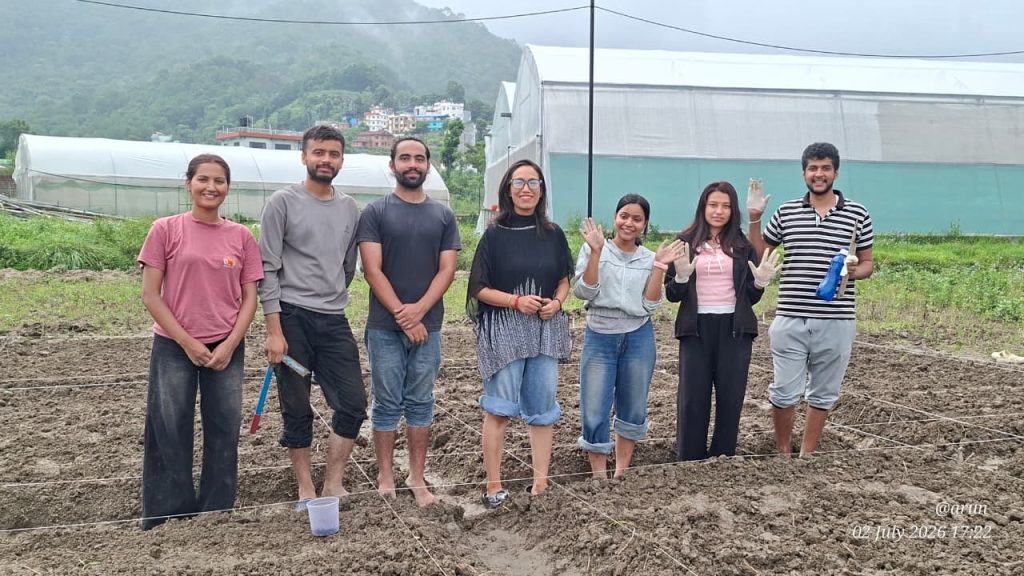
Master’s students demonstrating biofertilizer-based seed treatment as a climate-smart and agroecological agricultural practice.
The demonstration included prepared plots with triplicate treatments, control plots, individual microbial treatments, and consortia of native microorganisms. The control plots helped compare treated and untreated conditions, while triplicate plots supported reliable observation. The use of microbial consortia was important because different microorganisms perform different roles, such as nitrogen fixation, phosphorus solubilization, root growth promotion, and suppression of soil-borne diseases.
Photo 2: Seed Treatment and Coating with Indigenous Beneficial Microorganisms
Legume seeds treated with native microbial inoculants before sowing.
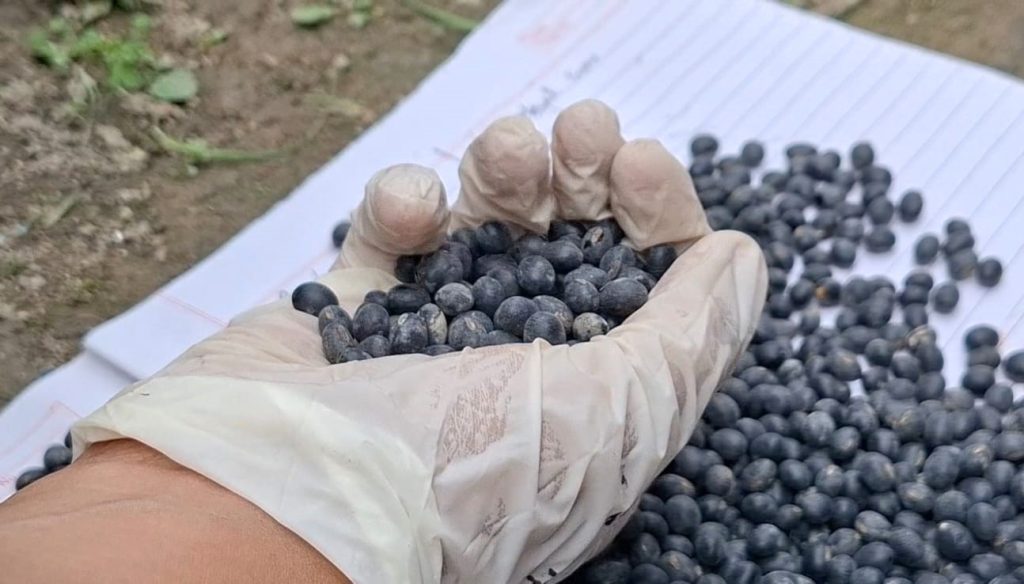
This practice is especially relevant for legume crops because legumes naturally form beneficial associations with microorganisms that support nitrogen fixation and improve soil fertility. By using indigenous microorganisms, seed treatment becomes more suitable for local soil and climatic conditions. This supports agroecological farming because it strengthens natural soil processes instead of depending only on external chemical inputs.
Photo 3: Climate-Smart Practice for Community Awareness
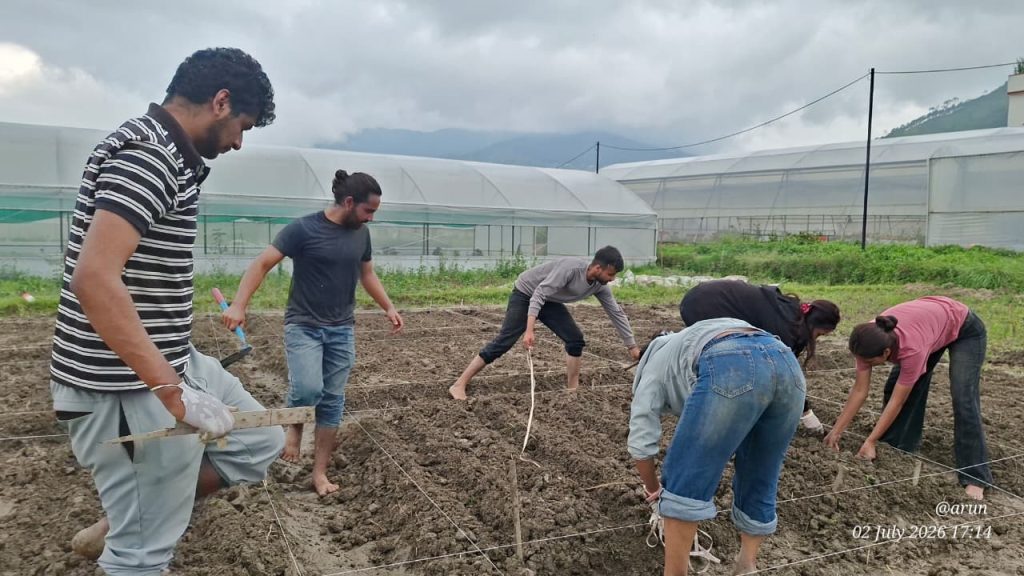
Field demonstration to adopt biofertilizer-based seed treatment.
This demonstration also carries an important awareness message. If academic institutions are practicing and demonstrating biofertilizer-based seed treatment, local communities should also adopt and benefit from it. Farmers, cooperatives, nurseries, and agricultural groups can learn from such field demonstrations and apply similar practices in their own fields.
Local agricultural service points such as Biomandu Organic can play an important role in spreading awareness and helping nurseries and horticulture access sustainable agricultural inputs. Biofertilizers are also becoming available through retail chain stores and online platforms in all over Nepal. For example, farmers and gardeners can explore biofertilizer products through platforms such as I Am the Gardener online store
Overall, biofertilizer seed treatment is not only a scientific practice but also a practical solution for sustainable farming. It improves soil health, supports stronger crops, reduces disease pressure, lowers chemical dependency, and builds resilience under changing climatic conditions. Urea and salt-based fertilizers may feed the crop quickly, but biofertilizers help keep the soil alive for long-term agriculture. The demonstration by Master’s students of IAAS, TU, under the supervision of Dr. Pooja Manandhar, showed that biofertilizers are a crucial climate-smart and agroecological method for the future of agriculture.